Every organization that does serious research holds two portfolios. One is visible: the patents, trademarks, and registered rights that appear in annual reports and due diligence files. The other is invisible: the thousands of questions, hypotheses, failed experiments, and half-formed ideas generated by its people every year.
Call the second one curiosity capital — the accumulated value of everything an organization wonders about, tests, and learns before anything is ever filed.
Most intellectual property (IP) strategies only account for the first portfolio. That is a measurement problem, and increasingly, a competitive one.
What is curiosity capital?
Curiosity capital is not a soft concept. It has a paper trail, or it should. It lives in:
- The lab notebook entry where a researcher noted an unexpected result and moved on.
- The hypothesis that didn't pan out for Project A but answers the central question of Project B two years later.
- The prior art search a team ran, learned from, and never documented.
- The engineer's workaround that quietly became standard practice without anyone asking whether it was protectable.
Individually, these are fragments. Collectively, they are the raw material of every future filing, every trade secret, and a significant share of enterprise value. Accounting standards have never known quite what to do with intangibles created internally; most balance sheets barely register them. But the market registers them constantly in acquisition premiums, licensing negotiations, and the valuation gap between companies that can evidence their innovation history and those that can only assert it.
Why does curiosity capital evaporate?
The problem is not that organizations lack curiosity. It's that curiosity is rarely captured in a form that survives.
An idea discussed in a meeting exists only as long as the people in the room remember it. An experiment recorded in a personal spreadsheet sometimes leaves when its owner does. A disclosure drafted by email lives in an inbox until the inbox is archived. By the time an organization decides something is worth protecting, the evidence of when it was conceived, who conceived it, and how it evolved has often thinned to the point of being unusable for a patent application, a trade secret claim, or a commercial negotiation.
This is why the endpoint-only view of IP is so costly. A filing is the last step of a long cognitive process. If the process itself is undocumented, the organization has captured the certificate and lost the asset's history, the very thing that establishes priority, inventorship, and defensibility.
The region might be generating curiosity capital faster than it's capturing it
This matters acutely in Saudi Arabia and the wider region right now. Saudi patent filings grew 13% in 2024, and filings by individual inventors more than doubled year over year in 2025 (Source: SAIP 2024 IP Statistical Report; SAIP 2025 IP Statistical Report). Universities are standing up innovation centers, national research programs are scaling, and Vision 2030 has made intangible assets a matter of economic policy, not just legal housekeeping.
Filing growth is the visible signal. Behind every filing are dozens of research threads that never reached one, not because they lacked merit, but because nothing in the organization's infrastructure was built to hold them. The regional opportunity is not simply to file more. It is to lose less.
Turning curiosity into a governed asset
Treating curiosity as capital means giving it what every other asset class has: a system of record, a chain of custody, and a path to value. In practice, that looks like three disciplines.
Capture at the point of thought. Invention doesn't begin at the disclosure form. Structured digital lab notebooks — where experiments, hypotheses, and findings are recorded as they happen — turn day-to-day research into a traceable, IP-ready record. This is the role NovaBook® plays inside NovaLexi®: documentation as a by-product of the work, not an afterthought to it.
Protect what shouldn't be filed. Not all curiosity capital should become a patent. Some of it is most valuable held as a trade secret — provided it is governed like one, with controlled access and tamper-evident records rather than a shared drive and good intentions. That is the discipline NovaVault™ exists to enforce.
Keep the reasoning, not just the result. The most under-valued layer of curiosity capital is the reasoning that connects a question to a conclusion. When AI supports the process — helping decompose claims, structure disclosures, and assess novelty — that reasoning can be preserved as structured state rather than lost in conversation. NovaAi® is built on this principle: it removes friction from the cognitive work around invention, while the act of invention stays human.
The strategic shift
The organizations that will lead the region's innovation economy are not necessarily the ones filing the most this year. They are the ones building the infrastructure to know what they know — to see their curiosity as a portfolio, manage it with the same rigor as their registered rights, and move assets deliberately from question to protection to value.
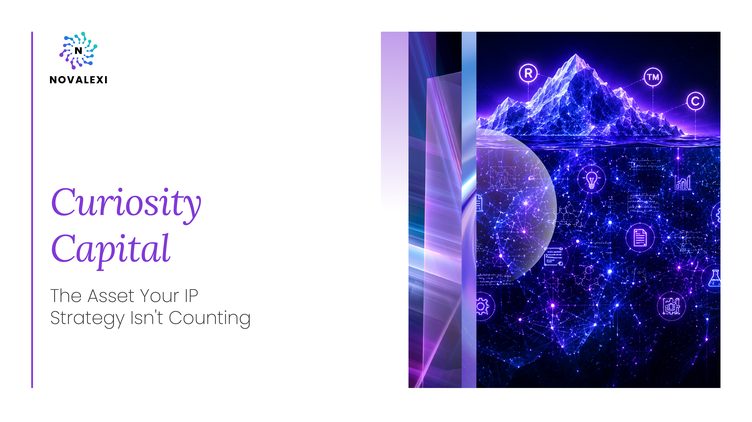
Registered IP is the part of the iceberg above the waterline. Curiosity capital is everything beneath it. The question for every research-driven organization is simple: how much of yours can you actually see?
Ready to see the whole iceberg? Contact us to see how NovaLexi can help you capture, govern, and realize the value of your organization's curiosity capital — from the first question to the registered right.