In the spring of 2020, aviation faced the worst market in its history. Fleets were grounded, revenue had collapsed due to the pandemic, and airline credit ratings were sinking deep into speculative territory. Yet, in the middle of that crisis, something remarkable happened. Credit rating agencies graded one of United Airlines' assets investment grade — three notches above the airline's own debt — and lenders put $6.8 billion behind it.
That asset had no wings. It had never carried a passenger. An intangible asset; it was MileagePlus, the airline's loyalty program — a brand, a member base, and a web of bank partnerships that most observers had filed under "marketing." The asset that helped save the airline was one that had never meaningfully appeared on its balance sheet.
Which raises the question every airline executive should be asking: what else is sitting invisible?
The invisible balance sheet
In June 2020, United disclosed to the Securities and Exchange Commission (SEC) that MileagePlus had been appraised at $21.9 billion — roughly twice the airline's entire market capitalization at the time. On the airline's books, the program had been carried at approximately nothing. The gap wasn't an error. It was the accounting system working exactly as designed.
The international financial reporting standards (IFRS) recognize an intangible asset when it is acquired at the price paid for it. But assets a company builds itself either cannot be recognized at all (a brand, a member base, a customer relationship) or appear — only when strict capitalization criteria are met — at what they cost to develop, never at what they are worth. The more original the asset, built from zero rather than bought, the more invisible it is.
And the blind spot keeps widening. Intangible assets made up roughly 17% of S&P 500 market value in 1975. By 2020, that figure had reached approximately 90%. The distance between what balance sheets show and where value actually lives has never been greater.
What dormant intellectual property (IP) looks like inside an airline
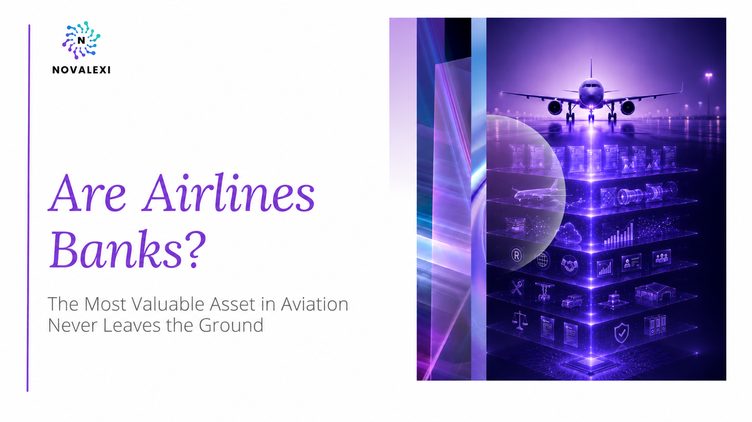
Take an inventory of any established carrier and you will find the same categories of unstructured value, built over decades and rarely examined as assets:
- The brand itself — and increasingly, sub-brands: cabin concepts, service marks, lounge identities, cargo brands.
- The loyalty program — the currency, the member data, the co-brand bank relationships, the redemption ecosystem.
- Operational software — scheduling engines, network planning tools, crew management systems, disruption-recovery logic.
- Engineering and maintenance know-how — predictive maintenance models, reliability data, turnaround processes refined across millions of flight hours.
- Service standards and training systems — the codified "how" behind the passenger experience.
- Route, traffic, and customer data — structured, licensable, and compounding every day.
None of this is dormant because it is worthless. It is dormant because it is unstructured; no clear title, no register, no contract isolating its economics, and therefore nothing a counterparty or lender can price.
The proof: from a rock star's experiment to investment-grade mega-deals
The securitization of intellectual property did not start in aviation. In 1997, David Bowie raised $55 million against the future royalties of his back catalogue — the first time music royalties had ever been securitized, and the deal widely credited with opening intellectual property securitization as a field. The entire issue was bought by Prudential. At the time, it looked like a curiosity.
Twenty-three years later, United turned that curiosity into the template for one of the most impressive financings in aviation history. The structure mattered more than the asset: United moved MileagePlus — brand, member data, partner contracts — into a separate, bankruptcy-remote subsidiary, effectively forming the SPV needed. The airline then licensed its own program back, committing to a contracted annual license fee. Co-brand bank payments flowed into pledged accounts, with lenders paid first.
The result: $6.8 billion raised in July 2020, in a financing structured by Goldman Sachs, against a program appraised at $21.9 billion, and rated investment grade while the parent airline sat three notches below. United never sold the program and never lost operational control. As the market put it at the time, the structure — not a sale — is what made the value bankable.
The industry noticed. Delta raised $9 billion against SkyMiles within months. American followed with $10 billion against AAdvantage in March 2021, secured by a program rated five notches above the airline that created it.
It helps to see what those numbers are actually made of. For example, a cardholder swipes their AMEX for $1,000 at a grocery store. The merchant pays AMEX an interchange fee — call it 2%, twenty dollars. AMEX owes the cardholder 1,000 "miles" as the reward. But AMEX can't mint Delta miles — only Delta can print Delta's currency. So, AMEX goes to Delta and buys those 1,000 miles, wholesale, at roughly one to two cents apiece. Real invoice, real cash, every month. Multiply by millions of cardholders swiping billions of dollars, and that's how Delta collected $4.1 billion from AMEX in 2019 — not for flying anyone anywhere. For selling currency.
Loyalty had stopped being a marketing line item. It had become an asset class.
Beyond loyalty: airlines as technology originators
Loyalty is the famous example, but not the only one. Lufthansa turned its internal operations software into NetLine, an enterprise suite serving dozens of airline customers worldwide, and positioned its AVIATAR platform as digital infrastructure for the wider industry. Air France–KLM commercialized its in-house predictive maintenance capability, PROGNOS, now deployed across other carriers' fleets. The Emirates Group built dnata into a global airport-services business spanning dozens of countries, and Singapore's Changi exported its airport operating know-how across continents.
In each case, the pattern is identical: capability built for internal use, identified as an asset, structured around contracts, and converted into recurring revenue that is often steadier than flying itself.
The new chapter: building it right from day one
Every case above involved retrofitting; taking assets built over decades and imposing structure on them after the fact, at considerable cost and complexity.
The more interesting question is what happens when an airline designs its intangible assets as assets from the start. That is what makes Riyadh Air's launch of RX Pay on July 23, 2026, worth reading closely. The world's first digitally native airline chose not to rent its name to a bank's card product — the traditional co-brand model. Instead, it built its own: a Riyadh Air card suite designed end-to-end by the airline, issued through leading Saudi banks, running on Mastercard's network under an exclusivity agreement in the Kingdom, and earning Sfeer Points on everyday spending — now redeemable anywhere the network is accepted, not just on flights.
Read through an IP lens, this is about ownership. The brand, the guest data, the partner economics, the phased architecture designed to expand market by market — these are the exact ingredients that, at United, took twenty years and a crisis to structure. Here they are being assembled deliberately, from day one, in an asset the airline controls.
That is what the next generation of aviation value creation looks like: IP treated as infrastructure, not paperwork.
The question is no longer whether — it's what, and where
The pattern across every case in this article is the same. The value was always there. What changed was that someone took inventory, established ownership, wrapped the asset in structure, and connected it to cash flow. The cost asymmetry is stark: governance and structure cost thousands today, or billions in forgone licensing, financing, and enterprise value later.
Most organizations genuinely do not know what they own. The brands, data, platforms, and know-how accumulate faster than anyone catalogues them, and the register, if one exists at all, rarely reflects where the value actually sits.
That discovery is where NovaLexi® comes in. The platform brings an organization's IP and intangible assets into one structured portfolio, clarifying ownership, surfacing protection and governance gaps, and helping teams assess which assets could support licensing, commercialization, partnerships, valuation, or financing.
If you have never taken that inventory, the honest answer is that you do not yet know what your balance sheet isn't telling you.
Ready to find out what your organization already owns? Contact us to see how NovaLexi can help you take inventory of your intellectual property and intangible assets, and turn them into structured, financeable value.